

Mole & skin lump checks
Moles that change in size, shape, or color, moles that bleed, and lumps in the skin all start with an examination. If needed, we take a biopsy (a small tissue sample), which is covered by National Health Insurance (NHI).
Where it often appears
Face · mainly epidermis to dermis
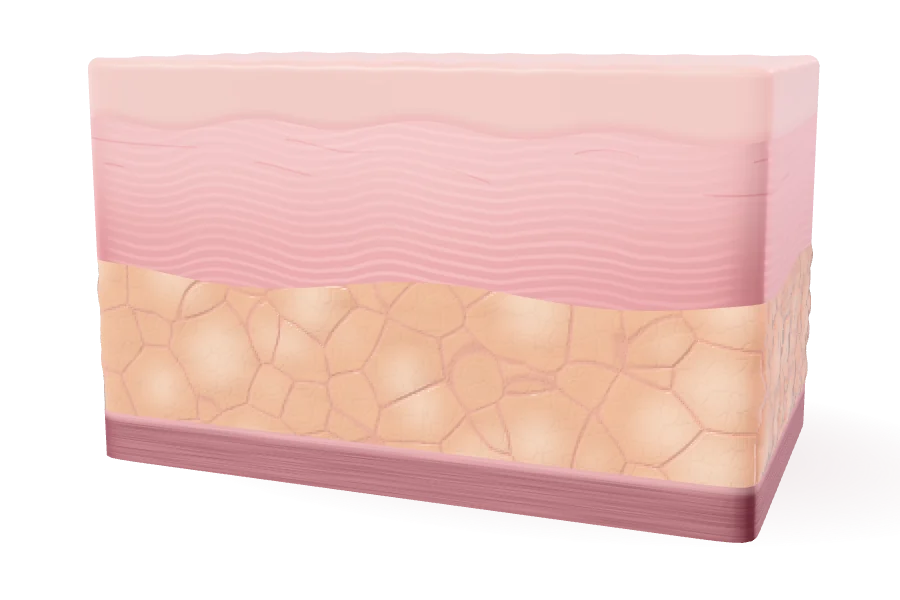
They form where cells gather in one spot. How deep they go depends on the type.
Skin model · not to scale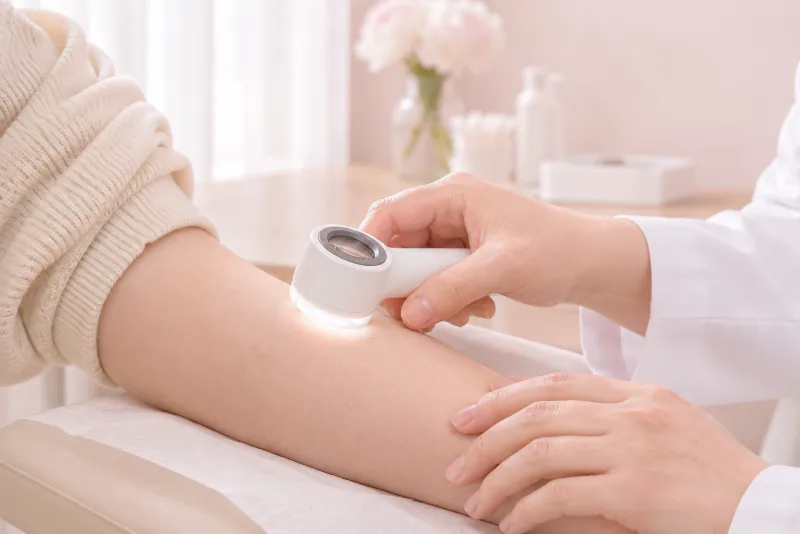
We start with a close look
Examination and tests
With a dermatoscope (a handheld lighted magnifier), we look at the mole’s color and shape at about 10x magnification.
We check whether the two halves differ, the border is uneven, several colors are mixed, the diameter is over 6 mm, or it has changed recently.
If anything looks suspicious, we remove a small piece for a biopsy (NHI covered). We go over the results with you when they come back.
- DermatoscopeMagnifies moles and lumps about 10 times to show their color and shape.
What brings people in
- A mole I already had has grown and become lopsided
- My mole bleeds and scabs over
- I’m getting more brown, wart-like spots on my face
- I can feel a soft lump under my skin
Why it happens
- A mole is a cluster of the pigment cells that make melanin.
- An age spot (seborrheic keratosis) forms when the outer layer of skin thickens with age and sun exposure.
- Lumps under the skin come in several kinds, such as a sac filled with keratin (an epidermal cyst) or a clump of fat.
They form where cells gather in one spot. How deep they go depends on the type. Layer thicknesses in this model are adjusted for clarity. In real skin, the dermis is more than ten times thicker than the epidermis.
Treatment
Examination
First, we find out what it is. Most turn out to be moles or lumps that are nothing to worry about.
Biopsy (NHI covered)
For a suspicious mole, we numb the area with a local anesthetic and remove a small piece for testing.
Next steps
If the results show you need surgery or further treatment, we refer you to a larger hospital. Removing a mole for cosmetic reasons is self-pay, and after the examination it continues as a mole and age spot removal treatment.
InsuranceExaminations of moles and lumps, and biopsies done for medical reasons, are covered by NHI. Removal for cosmetic reasons is self-pay (not covered by NHI).
Treatment is decided after the examination. How much it helps, and how quickly, varies from person to person.
What to do at home
Once a month, photograph your moles in the same light to compare their size and color.
Wear sunscreen and limit time in the midday sun.
Do not pick at moles or try to remove them at home with creams or tools.
Check your palms, soles, and nails from time to time as well.
Come in soon if
- A mole grows quickly or develops a mix of colors
- A sore bleeds and still has not healed after several weeks
- A dark vertical line appears on a nail or gets wider
During clinic hours, simply come in; no appointment is needed. Questions: +82-2-0123-4567
Common questions
Why do I need an examination before having a mole removed?
It is rare, but if a skin cancer is mistaken for a mole and removed with a laser, diagnosis can be delayed while the remaining cells keep growing. That is why we check what it is before removing it.
Will the biopsy hurt? Will I have a scar?
We use a local anesthetic, so you feel only a brief sting as it goes in. A small scar may remain where the sample was taken.
Can I use insurance to have a mole removed?
Removal for cosmetic reasons is self-pay (not covered by NHI). A biopsy taken because the examination raises a concern is covered by NHI.
See also
We decide on cosmetic treatment only after an examination confirms that care for the condition is finished, or that the two can go together. Cosmetic treatment prices include VAT.