

Hyaluronic acid filler
Hyaluronic acid gel is injected to fill areas such as smile lines (the folds running from nose to mouth) and hollow cheeks, for a temporary improvement.
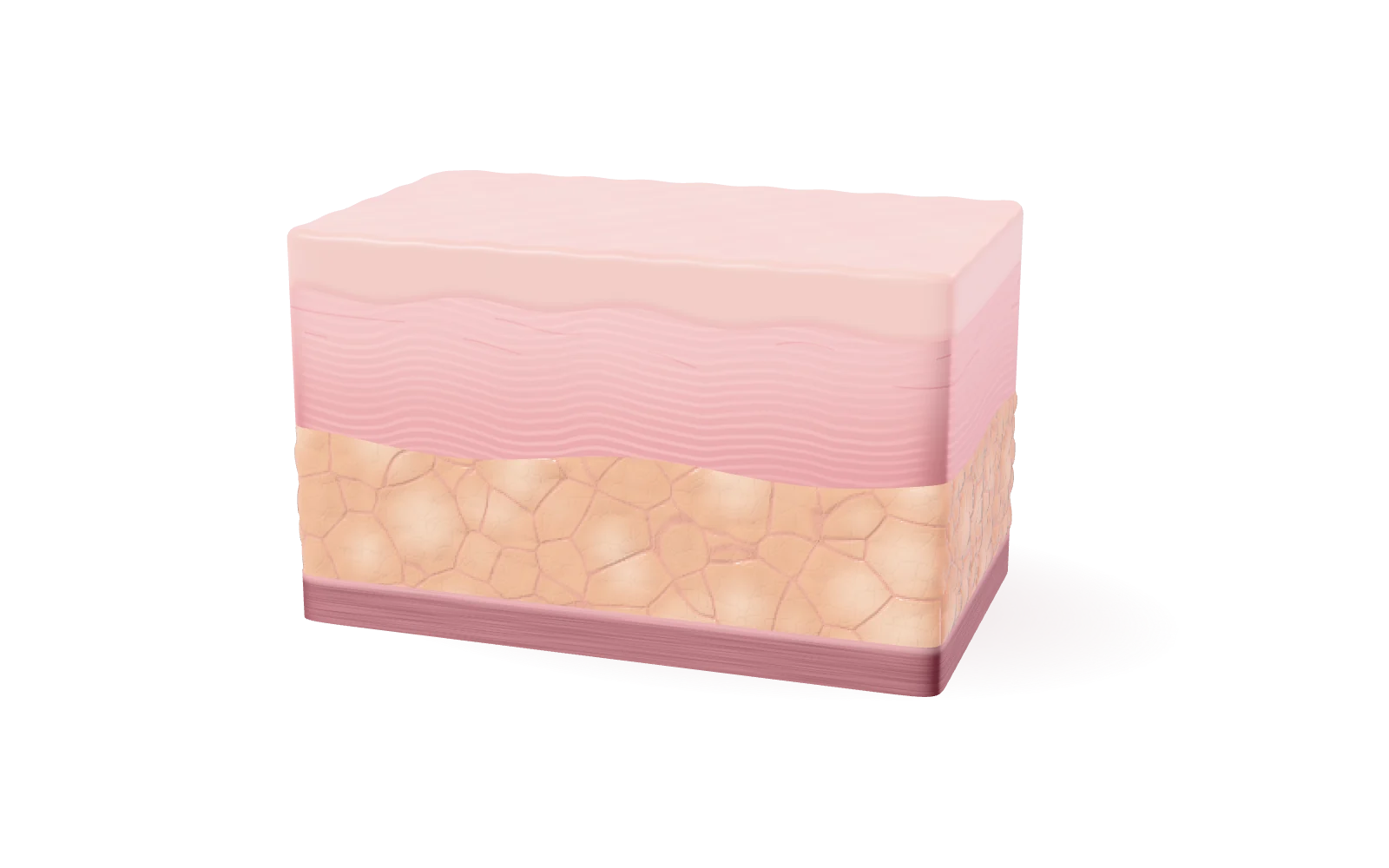
Depth: dermis to subcutaneous fat This is a model, so layer thickness is not to scale.
How it works
Examination firstWhere hollowness comes from sagging, a lifting treatment may suit you better than filler. We first examine which layer the change is in.
01What it uses
Hyaluronic acid gel
A gel form of hyaluronic acid, a substance already found in skin. It can be dissolved with an enzyme called hyaluronidase.
02Which layer
Dermis to subcutaneous fat
Lines are filled in the dermis, and hollow cheeks in the subcutaneous fat. Blood vessels run through these layers, so we inject away from where they lie.
03How it works
Filling hollow areas
The gel adds volume and softens shadows. As the body slowly absorbs it, the volume gradually decreases.
Concerns and how it works
If this sounds like you
- My smile lines look deep
- Hollow cheeks make me look tired
- Hollows around my mouth cast shadows
Over time, the face loses volume in its fat and around the bone, and shadows appear. Filler places hyaluronic acid gel in the dermis or subcutaneous fat to fill the hollow areas. It usually lasts 6–12 months. Because of a rare complication in which a blood vessel becomes blocked, we choose where and how deep to inject with great care.
Treatment details
Sessions, downtime, and side effects
- Usual sessions
- 1 session; usually lasts 6–12 months
- Interval
- Not applicable
- Treatment time
- 15–30 min
- Numbing
- Numbing cream, plus local anesthetic if needed
- Downtime
- Redness, swelling, and bruising usually settle within 1–2 weeks
What it is for
Temporary improvement of areas such as smile lines and hollow cheeks. How much your skin changes, and how quickly, varies from person to person.
Side effects
Swelling, bruising, lumpiness, and, rarely, inflammation can occur. Very rarely, a blocked blood vessel can lead to skin necrosis (tissue death) and, between the brows or around the nose, to reduced vision or blindness. If your skin turns white or dark red, or your vision becomes blurry after treatment, contact us right away.
Blocked blood vesselsVery rarely, filler can block a blood vessel. This can cause skin necrosis (tissue death) and, between the brows or around the nose, reduced vision or blindness. After treatment, if your skin turns white or dark red, or your vision becomes blurry, contact us right away. If a blocked vessel is suspected, we use the dissolving enzyme (hyaluronidase) immediately.
Is it right for you
When it suits you,and when it may not
- Good for: Your smile lines look deep
- Good for: Hollow cheeks leave shadows on your face
- Good for: You understand the change is temporary
- Good for: Your schedule allows for 1–2 weeks of swelling and bruising
- May not suit: Inflammation, infection, or severe acne in the treatment area
- May not suit: Pregnancy or breastfeeding
- May not suit: An area previously injected with a filler of unknown type (please tell us first)
- May not suit: Hollowness caused by sagging (a lifting treatment may suit you better)
Before and after
From before your visit back to daily life
- BeforeExamination, plan, and price
- Day of treatment15–30 min · numbing cream, plus local anesthetic if needed
- After 3 daysOK again: pressing and massage
- Around 14 daysUsually healed by now (varies by person)
Before treatment
- Tell us about any medicines or supplements that thin the blood. Do not stop a prescribed medicine on your own.
- If you have had filler or a thread lift before, tell us the date, area, and product.
- Swelling and bruising can last 1–2 weeks, so if an important event falls within that time, we reschedule.
- If you often get cold sores, let us know in advance.
After treatment
- Do not press on or massage the treated area for 3 days.
- Avoid sleeping face down or pressing your face hard into the pillow.
- Redness, swelling, and bruising usually settle within 1–2 weeks.
- If your skin turns white or dark red, the pain keeps getting worse, or your vision becomes blurry, contact us right away. Outside clinic hours, go to the nearest emergency room.
Price
The final price, VAT included
This is a self-pay fee. There are no discounts or promotional prices, and we go over each item and its price again before treatment.
- 1 cc (Korean-made product)₩220,000
Self-pay · final price, VAT included · as of Nov 2, 2026
SuppliesIncluded: 1 cc hyaluronic acid filler
MedicationIncluded: numbing cream
Common questions
What people often ask about hyaluronic acid filler
How much pain should I expect?
We apply numbing cream and use a local anesthetic if needed. You will feel a sting and some pressure as the needle goes in, and the sensation differs from person to person. The treatment takes 15–30 minutes.
How long will it take me to recover?
Redness, swelling, and bruising usually settle within 1–2 weeks. During that time, the area may feel lumpy to the touch.
How many sessions will I need?
One session, which usually lasts 6–12 months. Once it has been absorbed, we look at your skin again and decide whether to add more.
Can I combine it with other treatments?
Botulinum toxin is sometimes given on the same day. If you also plan a lifting treatment, we set the order and spacing after an examination.
Keep exploring
Other treatments in the same layer
Skin conditions in the same layer (covered by National Health Insurance): acne, hives (urticaria), and hair loss. Reaching the same layer does not make this a treatment for those conditions.